
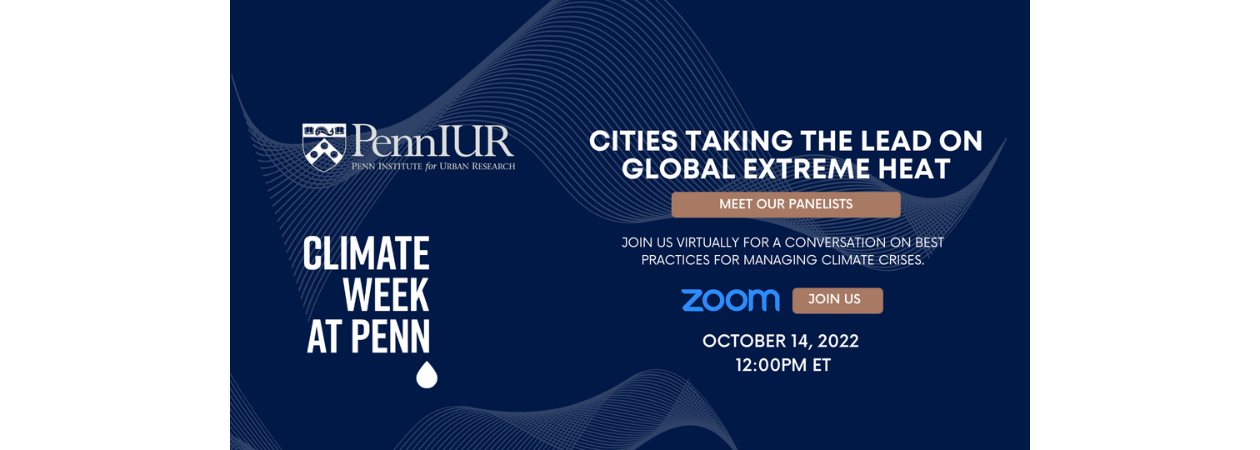
Cities Taking the Lead on Global Extreme Heat
Extreme heat is the climate-driven hazard that kills more people than any other. The recent heatwaves in Europe and the U.S. have produced enormous human, economic and environmental devastation. They have also generated a growing awareness about these climate hazards becoming more frequent, severe, and longer in the future, which reinforces the urgent need to activate top global leaders and organizations to embark on a “global crusade” to tackle extreme heat-related risks.
It is in cities where the threat and impacts from heat are most visible, and mayors from around the world are showing extraordinary leadership on the implementation of innovative tailored-made solutions to address extreme heat. However, mayors have also realized that effective local action should be accompanied by a Global Heat Advocacy Strategy aimed at delivering an urgent global call to action and mobilizing national governments, international organizations, International Financial Institutions, the private sector, NGOs, and Academia to embrace the urban heat agenda as a priority and support cities to address extreme heat-related impacts through concrete actionable solutions.
This 60-minute panel session will feature representatives from different cities to showcase their local best practices, as well as the leadership with which they are advocating for an effective global urban extreme heat agenda.
Panelists:
- Laura Ballesteros, Secretary of Sustainable Development, City of Monterrey, Mexico
- Cristina Huidobro, Chief Heat Officer, City of Santiago de Chile
- Eugenia Kargbo, Chief Heat Officer, City of Freetown, Sierra Leone
- Eleni Myrivili, Global Chief Heat Officer, UN Habitat
- Surella Segu, Chief Heat Officer, City of Monterrey, Mexico
- Moderator: Mauricio Rodas, former Mayor of Quito; Visiting Scholar, Penn IUR, Perry World House, and Kleinman Center for Energy Policy; Senior Fellow, Adrienne Arsht-Rockefeller Foundation Resilience Center.
Hosted by the Penn Institute for Urban Research and the Adapting to Extreme Heat Research Community (an EII-Penn Engineering-Penn IUR project)
Moderator

Mauricio Rodas
Mauricio Rodas is the Former Mayor of Quito, Ecuador, an office he assumed in 2014, when he became the youngest mayor in the capital city’s history. He is also currently World Co-President of the United Cities and Local Governments Organization. He serves as a member of the boards of the Global Covenant of Mayors for Climate and Energy, C40 Cities Climate Leadership Group, and the International Council for Local Environmental Initiatives. He is a Young Global Leader and member of the Future Global Council of Cities and Urbanization of the World Economic Forum. He is founder of Fundación Ethos, a Latin American think tank based in Mexico that develops responsible government models and projects on social and environmental policy. He has worked as a consultant in public policy for several ministries of the Mexican government, and has participated in the UN Economic Commission for Latin America and the Caribbean in Santiago de Chile and Mexico City. He has written for Foreign Policy, Letras Libres, PODER Magazine, and Diario Reforma, and has appeared as an analyst on CNN, Televisa, and TV Azteca. He holds a Juris Doctor from Universidad Católica de Quito and Master’s degrees in Government Administration and Political Science from the University of Pennsylvania.